
George Lloyd - Composer

 (1913 - 1998) 

Greetings,  and Welcome to the website of George Lloyd
Here you will find details of concerts, recordings, scores, orchestral material, photographs, reviews, and the biographical archive. 

In 2013, his centenary year, George Lloyd’s supporters are finally winning the fight for his contribution to British musical life to be recognised. There will be over 30 concerts of Lloyd's music this year, including a BBC Proms concert (Requiem) and the UK premiere of the recently discovered H.M.S. Trinidad March for Orchestra in the world-famous Last Night of the Proms at the Royal Albert Hall.  Other highlights include a revival of his hugely successful opera 'Iernin' and a performance of his large scale choral work 'A Symphonic Mass' in Truro Cathedral. To add icing to the Centenary birthday cake, The British Library will acquire the complete collection of George Lloyd's manuscripts for the nation. 

The sudden growth of interest in his music would have come as no surprise to George Lloyd. His whole career was a roller-coaster ride from the heights to the depths of musical fashion. Cited in the 1938 Oxford Companion to Music as a youthful prodigy, George Lloyd’s reputation never entirely overcame the change in the musical landscape which greeted him when he returned from serving with the Royal Marines in the 1942 Arctic convoys. But times changed, and although Lloyd's early success was brought to an abrupt end by the tragic fate of H.M.S. Trinidad, he enjoyed an extraordinary Indian Summer of popularity in the last twenty years of his life.His Centenary year in 2013 boasts more than 30 performances and gives perspective to his contribution.

 As The Times described it: 

‘Far from being the last romantic in the 20th century, he may well become the first in the 21st.'   

George Lloyd is best known as a composer of opera, symphonies, concertos, choral works and brass and chamber music, most of which he conducted himself. Although his music was stubbornly tonal and traditional in character, Lloyd was also an innovator.  In 1936, with his father and librettist, William Lloyd, he formed the New English Opera Company, with a mission to establish a school of English opera.  Their first project was an astonishing success - a long run of his opera Iernin, at The Lyceum - one of the largest theatres in London.  His second opera The Serf soon followed - this time at Covent Garden.

In 1951, when fragile health forced him to abandon the musical world, George Lloyd looked to the example of Giuseppe Verdi, the man he referred to as ‘his God’. He retreated to the country where he started a market garden, and pioneered modern growing techniques. Rising at 4.30 am every morning to compose, it was twenty years before he was strong enough to make his musical come-back. Years ahead of his time, and with the experience of founding the New English Opera Company in his twenties, Lloyd embraced new technology and established his own record company, his own publishing company, and his own distribution company.  

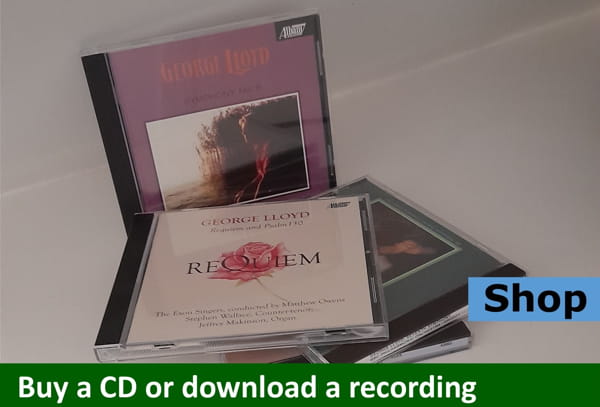
Now that he had direct access to his audience, George Lloyd achieved his independence from the musical establishment and went on to make 22 successful CD recordings on his own label, plus a further dozen with other commercial companies.  By a combination of traditional technique, independence and innovative thinking he established his music both critically and commercially.


“Critics were divided about Mr. Lloyd's music; some found it refreshingly communicative, others considered it old-fashioned. Even his detractors, however, recognized his compositional voice as authentic and original, not merely a 19th-century pastiche. Although his language is unabashedly tonal, there is a freshness in the melodic writing in the 12 symphonies he composed between 1932 and 1990, and there are engaging complexities in his solo piano works.”  NEW YORK TIMES, 10th July 1998


© Copyright Lloyd Music 2012. CMS Template design by Indent Limited, Kendal, UK